

 English
 русский
 عربى
عربى 11/09/2026 Industry
Mobile Solar Tower: Specs, Uses, and Diesel Comparison
Content
- 1 What a Mobile Solar Tower Actually Replaces on Site
- 2 How the System Generates and Stores Power
- 3 Core Specifications to Compare Before Buying
- 4 Where Mobile Solar Towers Get Used Most
- 5 Mobile Solar Tower vs Diesel Light Tower
- 6 Choosing the Right Configuration for Your Site
- 7 Maintenance and Expected Service Life
- 8 Return on Investment Over a Multi-Year Deployment
What a Mobile Solar Tower Actually Replaces on Site
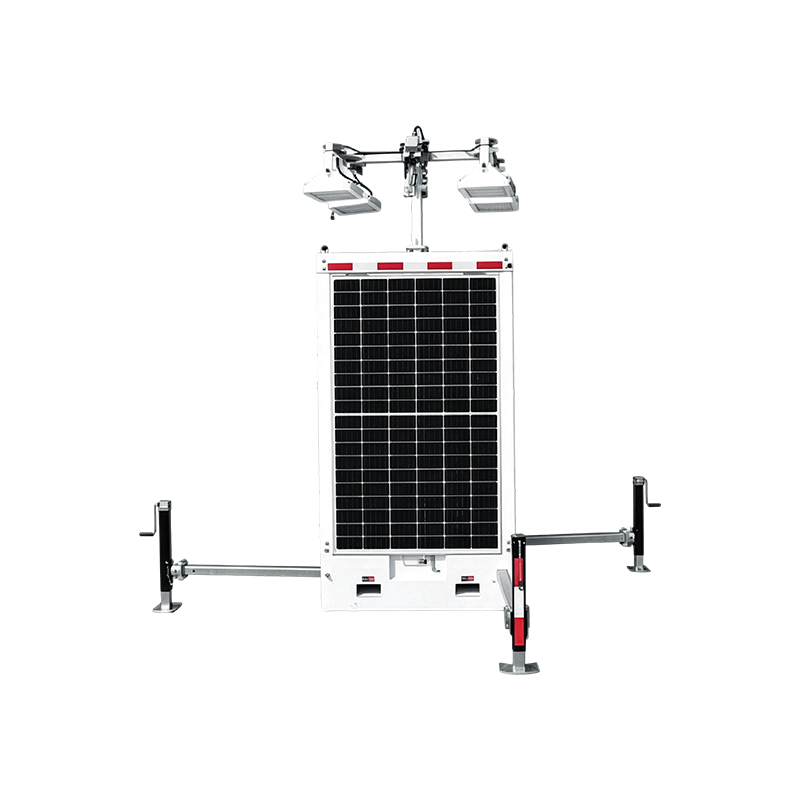
A mobile solar tower is a trailer-mounted lighting or power unit that runs on stored solar energy instead of diesel. It pairs solar panels, a battery bank, a charge controller, and a telescoping mast with an LED lighting head, so it can be towed to a job site, raised, and left running unattended for days without a fuel delivery. Current production units typically pair three 400-435W panels with a 9.6-19.2 kWh battery pack, enough to run the LED array for 21 to 32 hours per full charge.
That runtime figure is the number most buyers should check first, because it determines whether the tower can carry a site through cloudy stretches without a backup generator. Everything else on the spec sheet — panel wattage, mast height, lumen output — exists to support that one figure.
How the System Generates and Stores Power
The solar array charges the battery through an MPPT charge controller, which adjusts voltage and current to pull the maximum usable power from the panels even as sunlight angle and intensity change through the day. From a roughly 50% charge, most trailer-based systems recover to full in 7 to 15 hours of direct sun, which is why units are usually sized to fully recharge during a single daylight cycle even after a full night of lighting.
The battery bank — typically gel or LiFePO4 cells wired for a 24V system — feeds the LED head through the same controller, which regulates brightness and protects the cells from deep discharge. A single-axle trailer chassis with forklift pockets and a locking hitch handles transport, while the mast itself can be manual, electric, or hydraulic depending on how often the crew needs to raise and lower it.
Core Specifications to Compare Before Buying
Listed wattage is not a reliable way to compare units, since two towers with the same panel wattage can differ sharply in battery size, mast height, and light output. The table below lines up the ranges seen across small, mid-size, and large trailer-mounted towers currently on the market.
| Specification | Compact Unit | Standard Trailer | Heavy-Duty Trailer |
|---|---|---|---|
| Solar array | 200-300W | 3 x 400-435W | 2,000W+ |
| Battery capacity | 2-4 kWh | 9.6-19.2 kWh | 20 kWh+ |
| Light output | 4,000-14,000 lumens | 38,000-96,000 lumens | 100,000-150,000 lumens |
| Mast height | 2-3 m (tripod) | 6-9 m | 8-9 m telescopic |
| Runtime per charge | 6-10 hours | 21-30 hours | 30+ hours |
Where Mobile Solar Towers Get Used Most
The same features that make these units useful — no fuel, no wiring, fast repositioning — line up with a specific set of job types rather than general-purpose lighting:
- Construction sites needing overnight security lighting without a fuel line item
- Highway and road maintenance zones where a tower gets moved every few days
- Mining and oil field operations in locations with no grid access at all
- Disaster relief and emergency response staging areas set up on short notice
- Outdoor events and temporary parking lots needing several nights of coverage
- Perimeter security and surveillance camera mounts on remote yards
A single 24.6 ft telescopic mast unit can light up to roughly a quarter-acre at usable brightness, which is why one tower per staging area is often enough for mid-size construction or event footprints.
Mobile Solar Tower vs Diesel Light Tower
The comparison that matters most to a site manager is operating cost and labor, not just the sticker price. A diesel tower burns fuel around the clock and needs a technician to visit for refueling and oil checks; a solar tower needs neither once it's positioned correctly.
| Factor | Mobile Solar Tower | Diesel Light Tower |
|---|---|---|
| Fuel cost | None | 1-1.5 gal/hour, refueled every 2-4 days |
| Noise level | Near silent | 70-75 dB at close range |
| Routine maintenance | Panel cleaning, annual battery check | Oil changes, filters, fuel system service |
| Site restrictions | Usable in noise- and emissions-restricted zones | Often excluded from urban or environmentally sensitive sites |
| Weather dependency | Runtime drops in extended overcast conditions | Runs regardless of weather, as long as fuel is delivered |
The weather line is the honest tradeoff. A solar tower sized with a few days of battery buffer handles a stretch of cloudy weather fine; one sized too tight for its light load will run short exactly when a crew needs it most.
Choosing the Right Configuration for Your Site
Battery capacity and expected runtime
Match the battery size to how many hours of light are actually needed per night, not the maximum the unit can produce. A site running a tower for 10 hours a night needs far less battery buffer than one running lights continuously for security through a full 24-hour cycle.
Mast height and coverage area
Taller masts throw light over a wider radius but need a larger, more stable trailer footprint. A 6-9 meter mast covers most construction and event layouts, while a 24-27 ft telescopic mast suits larger mining or highway staging areas where fewer towers need to cover more ground.
Lighting output and lux requirements
Lumen totals only tell part of the story — check the average lux the manufacturer quotes for a given footprint, since two towers with the same lumen rating can differ in how evenly that light is distributed across the ground.
Maintenance and Expected Service Life
Maintenance on a mobile solar tower is light compared to a fuel-powered alternative. Routine upkeep is mostly:
- Wipe down solar panels periodically to remove dust, which can measurably cut charging efficiency if left to build up
- Inspect the mast locking mechanism and winch or hydraulic lines before each redeployment
- Check battery terminals and cooling vents annually, or per the manufacturer's service interval
- Confirm trailer tires, brakes, and hitch hardware before long tows between sites
LED heads on these units are typically rated for tens of thousands of hours, and gel or LiFePO4 battery packs are commonly warrantied for multi-year service, so the components that fail first are usually mechanical — hinges, winches, and tow hardware — rather than the power system itself.
Return on Investment Over a Multi-Year Deployment
The upfront cost of a solar tower runs higher than a comparable diesel unit, but the gap closes fast once fuel and labor are factored in. A diesel tower burning fuel continuously at a typical job site can rack up a meaningful monthly fuel bill on top of scheduled service visits, while a solar tower's ongoing cost is close to zero after installation.
For sites that run towers for extended stretches — months rather than days — the fuel and maintenance savings alone typically offset the higher purchase price within one to two years of continuous use, after which the solar unit runs at a lower cost than diesel for the rest of its service life. Sites that only need a tower for a few days at a time see a slower payback, which is where rental fleets of solar towers tend to make more sense than an outright purchase.
You May Also Like

Copyright © Ampora Technology Co., Ltd. All Rights Reserved.
Mobile Solar Container Manufacturers Solar Power Container Solution