

 English
 русский
 عربى
عربى
-
01
 01. SMART O&MAutomated operation reduces manual intervention and overall O&M costs. Intelligent monitoring, remote diagnostics, and automated maintenance help maintain panel performance and overall system efficiency.
 -
02
 02.EASY O&MManual inspection and cleaning provide a cost-effective and easy-to-manage O&M solution for small-to-medium projects and temporary power applications. Routine maintenance and cleaning help reduce power loss caused by dust accumulation.
 -
03
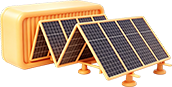 03.CUSTOMIZED SERVICESCustomized solutions based on specific project requirements, including system power, energy storage capacity, on-grid/off-grid modes, appearance and structure, special interfaces, and remote management functions for greater system adaptability and cost efficiency.
 -
04
 04.AFTER-SALES SUPPORT-Installation guidance and remote training
-Video tutorials and operating instructions
-Fault diagnosis and technical support
-Spare parts support and long-term service plans
-
Can the solar container be integrated with an existing diesel generator? Is a separate controller or microgrid system required?
Yes. The solar container can be integrated with the customer's existing diesel generator set. An ATS or STS can be used for system switching and control, depending on the specific site conditions and project requirements.
-
How long does it take to deploy and pack up the system? How many workers are required?
Deployment takes approximately 2 hours, while packing up the system takes about 1 hour. A team of 3–4 trained workers is typically required.
-
How durable is the folding structure? How frequently can it be deployed and folded? What material is used for the rails?
The current design is intended for approximately 10 deployment and folding cycles per year. For applications requiring more frequent deployment, the container body, structural components, and connection points can be redesigned for greater durability. The rails are made of zinc-aluminum-magnesium alloy.
-
How is the system secured against strong winds?
Once the folding frames are fully extended and secured, locking pins are inserted into the square holes at the hinge ends. Steel cables connect the locking pins to ground anchors, with tensioners used to adjust cable tension.
For soft ground such as soil or grass, ground anchors can be driven directly into the ground. For concrete surfaces, the steel cables can be secured to hooked expansion bolts anchored into the concrete.
-
What is the wind resistance rating after deployment? Are ground anchors required?
The deployed system is estimated to withstand winds up to Beaufort Force 12. Ring-type locking pins are inserted into the square holes on the sides of the frames and connected to ground anchors using steel cables and tensioners.
For soft ground, ground stakes can be driven directly into the soil. For hard surfaces such as concrete, the system can be secured using suitable anchoring or counterweight solutions.
-
How are the PV modules protected during transportation?
The PV modules are mounted within the folding frames. Once the frames are folded into the container, limit pins at the top of the container secure each frame section in place.
Wooden support blocks are then placed underneath the frame to keep the wheels off the container floor, helping prevent axle deformation caused by vibration and road impact during transportation. Shock-absorbing foam is also placed over the outermost PV modules to protect the glass from impact and damage.
-
Does the installation site need to be level?
Yes. The installation area should meet certain ground-level requirements.
The level tolerance between the two transverse support points is ±5 cm over a distance of approximately 2.4 m. For the two longitudinal support points, the tolerance is ±10 cm over approximately 3.54 m.
When fully deployed, the system extends approximately 90–100 m. Using the container position as the reference level, the recommended elevation tolerance over the full 100 m length is within ±50 cm.
-
What installation guidance and O&M support do you provide?
We provide technical support for system deployment and dismantling, including illustrated installation guides, video tutorials, and remote technical assistance.
Routine maintenance and day-to-day deployment are handled by the purchaser. At present, we do not provide continuous on-site O&M services, but our technical team remains available for remote support when needed.
-
Can the system be customized?
Yes. We offer customization based on specific project requirements, including power capacity, system appearance, intelligent monitoring, backup diesel generator interfaces, special communication protocols, and other system configurations.
Once the technical requirements are confirmed in the contract, our team will evaluate the project and develop a suitable configuration to meet the agreed performance and functional requirements.
Contact Us
Copyright © Ampora Technology Co., Ltd. All Rights Reserved.
Mobile Solar Container Manufacturers Solar Power Container Solution